What Is a Marketing System: A Definition for Marketing Leaders
A definitional piece for CMOs, marketing VPs, and sales leaders who already know the playbook and have started to suspect it's missing a chapter.
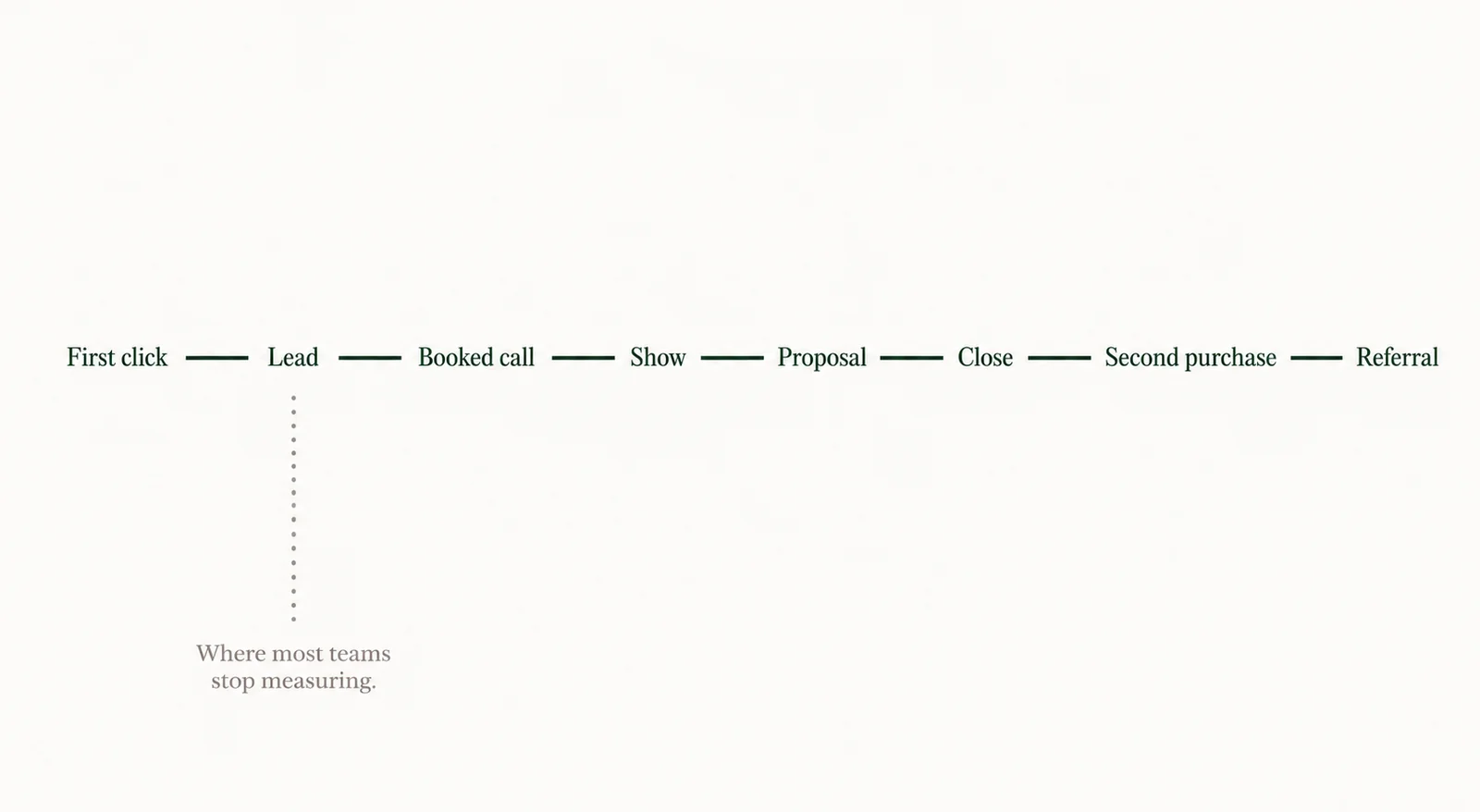
You're hitting your lead targets. Traffic is up. Campaigns are shipping. The dashboards look healthy.
And the revenue conversation is still hard.
The CEO wants to know why pipeline isn't converting at the rate the lead volume suggests. The CFO wants to know why customer acquisition cost isn't coming down even though channel performance is improving. The board wants to know what's behind the gap between the marketing scorecard and the revenue line. The honest answer, the one most marketing leaders won't say out loud, is that the team doesn't fully know.
This isn't a marketing problem. It's a marketing systems problem. And the conventional playbook doesn't tell you that, because the conventional playbook stops at the lead.
A scene from a board review
Picture a board review at a $14M home services company. Cost per lead is down. MQL volume is up. The deck looks clean through slide eight.
Slide nine is the revenue chart. Acquisition cost is rising. Close rates are drifting. The CFO asks the marketing leader one question: which lead source produced the most closed revenue last quarter, not just the most leads?
She doesn't have the answer. Nobody on her team has the answer. The data exists in seven different places and nothing connects them. The board moves on to the next agenda item, but the meeting after that meeting, the one in the CEO's office, is the one that actually matters.
I've watched some version of that scene play out across years of service-business engagements. The marketing leader is doing everything the playbook tells them to do, and the revenue line still isn't where it should be. The gap isn't in their effort. It's in what they were trained to count as marketing's job.
The diagnosis
The conventional definition of marketing ends at the lead. The funnel diagram tapers to a point at conversion and stops. The dashboards report cost per lead, not cost per closed deal. Every piece of the standard practice quietly reinforces the idea that marketing's job is finished when the form gets submitted.
So the team builds the first half of the system beautifully. The leads arrive on schedule. And the revenue still doesn't follow.
The gap between leads and revenue isn't a marketing problem. It's a marketing systems problem. The teams that figure this out stop trying to fix it with more campaigns and start fixing it with a different definition of what they're building.
This piece is that definition. What a marketing system actually is, the four places most teams skip, and the five questions that tell you which kind of system you currently have.
What a marketing system actually is
A marketing system is the integrated set of channels, tools, processes, content, data, and workflows that move a stranger to a customer and back again for the next purchase. It generates demand, captures it, qualifies it, hands it off, enables the sale, measures what produced the revenue, and runs on infrastructure that lets the operation work without depending on individual heroics.
The keyword is integrated. A team can have every individual piece in place and still not have a system. Website, CRM, email platform, sales team, proposal tool, scheduling tool, dashboard, attribution model, agency on retainer. Every component licensed and operational. The pieces don't talk to each other and nobody owns the connections between them. That's a software stack, not a system.
A marketing system has three jobs. Get them right and the rest of the operation gets easier. Get them wrong and you'll spend the next four quarters buying more traffic to compensate for a system that leaks in the middle.
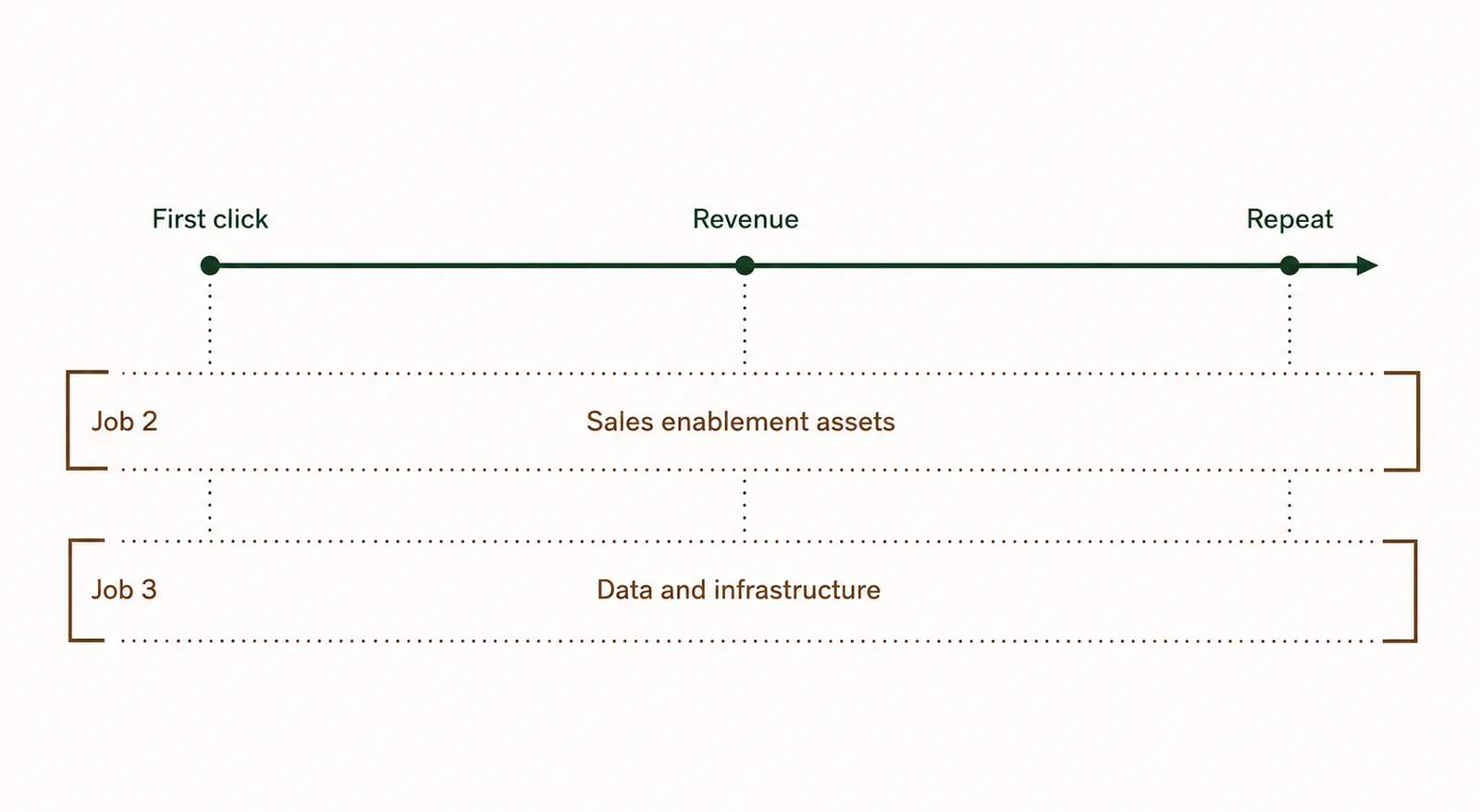
Job one: move people from first click to closed deal
Marketing's responsibility ends at revenue, not at the form fill.
Between the lead and the closed deal sits a series of conversion events that nobody is explicitly designing. Form fill to booked call, booked call to show, show to proposal, proposal to close, close to second purchase. Each one has its own drop-off. Each one is a place where the system either holds or leaks.
When marketing owns the path all the way to revenue, those conversion events become design problems. When marketing washes its hands at the lead, they stay accidents and the leak gets blamed on sales.
Job two: enable sales to do their best work
Sales enablement is a marketing system output, not a separate department's problem.
Walk into most service businesses and ask what the sales team has in their hands when a qualified lead arrives. The honest answer is usually whatever they built themselves, on the fly, last time they needed it. The proposal is a Word doc someone rebuilds every week. The objection responses live in the heads of the two reps who've been there longest. The case study that would close the deal is sitting in a folder nobody remembers.
The assets that close deals carry the brand, the positioning, the proof. They're marketing assets. If marketing isn't building them, sales is building them in the dark, and the quality of every deal depends on which rep happens to be working it.
Job three: power the business with data and infrastructure
A marketing system is also the data layer and the plumbing the rest of the business runs on.
The data side tells you the truth. Which channels produce revenue, not just leads. Which segments close fastest. Where deals stall. Which campaigns look great on the surface and underperform once you trace them to closed business. Most teams don't have this because the measurement architecture was never built. The dashboards report what the ad platforms hand them. Lead source gets overwritten on the second touch. Closed-loop reporting from sales back to marketing happens in someone's head, if at all. The data is technically present and operationally useless.
The infrastructure side lets the system actually run. Integrations between the website, the CRM, the email platform, the calendar, the proposal tool. Automations that route leads, send notifications, trigger follow-ups, update records, and keep the data clean. The plumbing that turns a five-step manual process into a single trigger.
Most marketing leaders underinvest in infrastructure because it doesn't show up in a campaign brief and it's hard to point at in a board deck. It's the difference between a system that works for a team of three and a system that holds up at thirty.
These three jobs, taken together, are the definition. A marketing system generates demand, captures it, qualifies it, hands it off cleanly, enables sales to close it, measures what moved the revenue number, and runs on infrastructure that absorbs the work instead of multiplying it. First click to closed deal. End to end.
The four parts most teams skip
Most marketing operations are well-built above the form fill. The demand generation is sophisticated. The capture infrastructure is in place. The nurture sequences are running. The CRM has a license for everyone who needs one. That's the half the conventional playbook tells you to build.
The other half is where the closed deals come from. It's also where most teams have the biggest gaps.
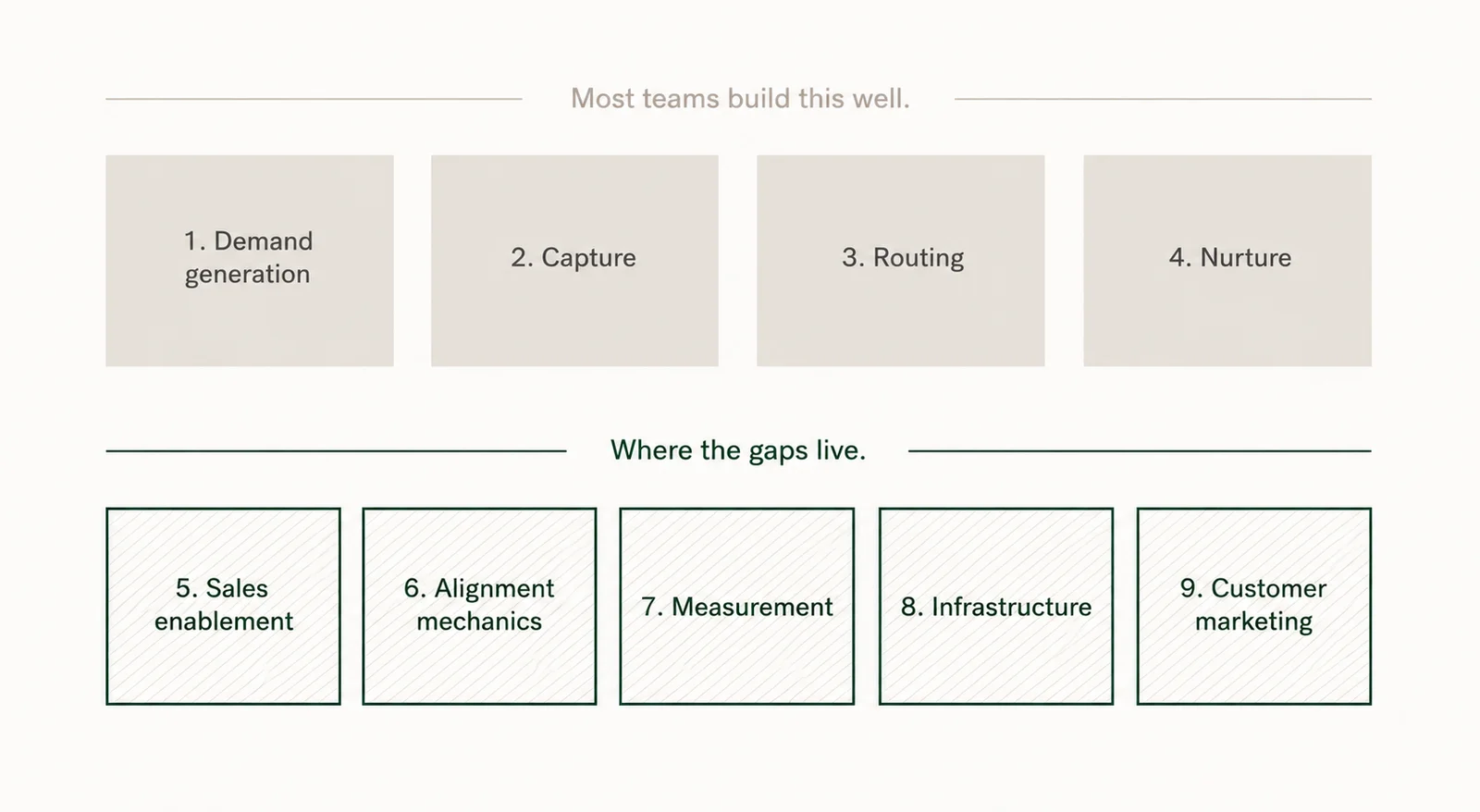
1. Sales enablement assets
What sales has in their hands when a lead arrives.
Decks, one-pagers, case studies, proposal templates, objection libraries, follow-up cadences for every deal stage, talk tracks for common scenarios, ROI calculators. The artifacts that turn a sales conversation into a closeable deal.
The test is specific. Pick a deal stage and ask what asset the rep should have. Discovery call? Booked call confirmation, agenda template, qualification framework. Post-discovery? Tailored follow-up, relevant case study, decision-maker brief. Proposal stage? Proposal template, references list. No-show? Recovery sequence. Stalled deal? Re-engagement track. Closed-lost? Win-back sequence on a ninety-day delay.
Most teams have two or three of these. A system has all of them, organized, accessible, and updated. The difference shows up in the close rate.
2. Sales and marketing alignment mechanics
The operating system between the two teams.
Everyone says they're aligned with sales. Few teams have the mechanics that make alignment real. The mechanics are concrete. A written and shared definition of qualified, reviewed at least quarterly. SLAs on response time and lead handoff, with reporting on whether they're hit. Pipeline reviews where sales and marketing look at the same numbers together. Closed-loop reporting from sales back to marketing, telling them which leads closed, which leads died, and why.
Without the mechanics, sales and marketing run on parallel tracks that occasionally collide. With them, the two teams operate as one revenue function with two specializations. The handoff stops being a fault line and starts being a designed event.
3. Measurement and analytics
The instrumentation that tells you what's working.
Source-to-revenue tracking, attribution modeling, leading indicator dashboards, lagging indicator reporting, conversion rate analysis at every funnel stage, channel performance, segment performance, sales cycle analytics. The layer that turns the system from a black box into something you can actually read.
The questions a marketing leader should be able to answer concretely: which channel produced the most closed revenue last quarter, which segment closes fastest and at what rate, where in the funnel are deals stalling, which leading indicators predicted last quarter's revenue and are they trending up or down right now.
If those questions take a week of analyst time to answer, the measurement layer isn't built yet. If they take ten minutes, the system is doing its job.
4. Customer marketing and retention
The system doesn't end at the first close.
Onboarding, expansion, referral mechanics, reviews and testimonials, customer success content, win-back campaigns, account-based nurture for existing accounts. The components that turn a closed deal into a second deal, a third deal, and a referral.
For most service businesses, the math here is brutal in a good way. A repeat customer costs a fraction of a new one. A referred customer closes faster and at higher rates than a cold lead. A review or testimonial from a happy customer does demand generation work for free, in perpetuity. Customer marketing is the component with the best unit economics in the entire system, and most teams treat it as someone else's job.
The path from first click to closed deal isn't the whole loop. The whole loop is first click to closed deal to second close to referral. The system designed for the loop produces compounding returns. The system designed for the single sale resets to zero every quarter.
How to know what kind of system you have
Five questions a marketing leader can answer in their head, right now, without pulling up a dashboard.
1. Which lead source produced the most closed revenue last quarter, not just the most leads?
If the answer is fast and confident, your measurement architecture is doing real work. If the answer requires a meeting with the analytics team, the system has a measurement gap, and every channel decision is being made with incomplete information.
2. What does your sales team have in their hands when a lead arrives, and is it the same every time?
If every rep is working from the same playbook, the same proposal template, the same case study library, and the same follow-up cadence, sales enablement is built. If every rep has their own version of everything, the close rate is being determined by which rep happens to be on the call.
3. Where does a lead sit two minutes, two days, and two weeks after a form fill?
The two-minute answer tells you whether routing and SLAs are real. The two-day answer tells you whether the nurture sequences exist. The two-week answer tells you whether the long game is being played. Most teams can answer one of the three with confidence. The system requires all three.
4. Which of your dashboards drive decisions, and which ones just get glanced at?
A mature measurement architecture has a small number of dashboards the team actually uses to make calls, and the rest are de-emphasized or retired. If every dashboard is theoretically important and none of them changed a decision in the last quarter, the measurement layer is doing decoration instead of work.
5. If your inbound volume doubled tomorrow, what would break first?
The stress test. The answer reveals where the system is held together by manual work or tribal knowledge. The honest answers from most teams: response time would slip, data hygiene would degrade, proposals would get rebuilt under pressure, and someone on the team would burn out. A system built to handle the load doesn't have those answers.
The diagnostic isn't a scorecard. It's a map of where to look. The teams that get the most out of these five questions don't try to fix everything at once. They find the weakest answer, fix it, and run the diagnostic again in ninety days.
The work is finishing the system
A marketing system runs from first click to closed deal. It generates demand, captures it, qualifies it, hands it off cleanly, enables sales to close it, measures what moved the revenue number, and runs on infrastructure that absorbs the work instead of multiplying it.
Most teams have built the first half well. The demand generation is sophisticated. The capture infrastructure is in place. The nurture sequences are running. The CRM has a license for everyone who needs one.
The work is finishing the system. Sales enablement assets that close deals instead of describe products. Alignment mechanics that turn the handoff into a designed event. Measurement that tells you the truth about what produces revenue. Customer marketing that turns the first close into the second one.
That's where the gap usually lives. Not in the team's effort, not in the channel mix, not in the campaign quality. In the four places the playbook never told them to build.
Naming which one is yours is the first move. The teams that get this right stop competing on traffic and start competing on conversion through the entire funnel. That's a competition most companies aren't set up to win, and the ones that are win it for years.
If you read the diagnostic and the weakest answer was obvious, you already know where to start. If it wasn't obvious, that's usually a signal that more than one component is half-built and the gaps are interacting. Mapping that is the work.
Marketing Systems Consultant. I help service businesses find and fix the gaps between their website, leads, and sales.